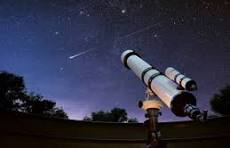
A telescope is a powerful optical instrument that collects and focuses light from distant objects. It makes celestial bodies appear brighter, clearer, and larger than they ever could to the naked eye. From amateur backyard stargazing to deep-space exploration, these instruments serve as our ultimate window into the universe.
🌌 Main Components of a Telescope
Every standard telescope relies on a few fundamental parts to capture and process light:
- Objective (Aperture): The primary lens or curved mirror located at the front or bottom of the telescope. It serves as the main light gatherer.
- Eyepiece: A smaller lens near the viewing end that takes the concentrated light and spreads it across your retina, creating a magnified image.
- Optical Tube: The structural housing that keeps the optics perfectly aligned while protecting them from dust and stray light.
- Mount: The mechanical base that holds the tube steady and allows you to track celestial objects with precision.
How It Works
The process of bringing distant galaxies into view happens in three distinct steps:
- Light Collection: A distant object, such as a star or planet, emits or reflects light. The telescope’s large objective lens or mirror captures a much wider beam of light than the small pupil of a human eye.
- Focusing: The curved shape of the objective bends (refracts) or bounces (reflects) these light rays inward. They converge at a single spot called the focal point, forming a sharp, miniature image.
- Magnification: The eyepiece picks up that concentrated image at the focal point and magnifies it, allowing your eye or a camera to see fine details.
Main Types of Telescopes
Telescopes are primarily categorized by the optical elements they use to gather light:
- Refracting Telescopes: These instruments use curved glass lenses at the front to bend and focus incoming light. While they offer crisp, high-contrast images, they can be prone to chromatic aberration—an optical distortion that causes unwanted colored fringes around bright objects.
