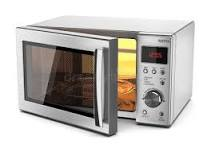
A microwave oven is a compact electrical appliance that heats food using invisible electromagnetic waves rather than hot air.
How They Operate and Function
- Magnetron Generation: A special vacuum tube called a magnetron turns electricity into high-power microwave energy.
- Waveguide Transmission: A metal tube known as a waveguide channels these waves directly into the cooking compartment.
- Dielectric Heating: The waves flip back and forth billions of times per second. This rapid shift forces water, fat, and sugar molecules to spin and collide, creating heat through friction.
- Penetration & Conduction: Waves reach about 1 to 3 centimeters (up to 1.5 inches) deep into the food. The inner core then warms up as heat spreads inward from those outer layers.
- Even Distribution: A spinning glass plate or internal fan moves the food through wave patterns so it heats more evenly.
- Containment & Safety: Solid metal walls bounce the waves around, and a perforated metal screen on the door acts as a Faraday cage. It traps the radiation inside while letting you look at your food.
Main Uses
- Reheating: Warms up leftover plates, coffee, or soup in seconds without drying them out.
- Defrosting: Uses low-power pulses to thaw frozen meat, bread, or vegetables smoothly.
- Cooking: Quickly steams or cooks high-moisture foods like fish, rice, and fresh vegetables.
Special Functions (Advanced Models)
- Convection Baking: Blends a hidden heating element with a fan to brown and bake foods just like a standard oven.
- Grilling / SlimFry: Employs built-in grill coils or low-oil air-frying tech to make food crisp on top.
- Sterilization: Uses hot steam cycles to clean baby bottles and small kitchen tools. [1]
Corrections Made to the Original Text
- Clarified that microwaves do not heat food “from the inside out” as a total rule; instead, they heat the outer 1 to 3 cm directly, and the center cooks via thermal conduction.
- Removed minor grammar and flow bumps to make the technical terms easy to read.
